Refereeing in Selected Non-Invasion Sports Games
Refereeing Non-Invasion Sports Games
- Aspects of refereeing with Regard to School Physical Education
- „Play, Study, Referee”
- Referee Position and Movement
- Signaling and Communication
Refereeing in selected Non-Invasion Sports Games:
Volleyball
Currently, a volleyball match is officiated by one to four referees (Czech Volleyball Extraliga and international competitions), who have rights, duties, and criteria for decision-making consistency defined by the rules of the game. Within School Physical Education (hereinafter SPE), the match is typically officiated by a single referee, generally the Physical Education teacher. From the referee's perspective, officiating volleyball addresses the issue of faults and violations. Mastering these basics should contribute to the publication's goal – enabling the individual to officiate a volleyball match at the given level.
Below, we list the fundamental rules necessary for game management within School Physical Education. Simultaneously, we deem it necessary to point out the Colored Mini-Volleyball Project, which has its own specific rules and restrictions. This entire project uses methodological steps (court size, number of contacts, allowed hitting techniques, etc.) to lead beginners toward the official version of volleyball. We recommend familiarizing yourself with this project¹. We will continue with the official voleyball rules (2025) thereafter.
Interpretation and Signaling of Fundamental Rules
Every decision made by the referee during a match is presented in four steps:
- Whistle: Starts the rally.
- Whistle: Ends the rally.
- Signaling: Executes the signal for the violation or fault.
- Pointing: Indicates the side of the team that gains the point from the rally.
Serve
In this section, we present the main gestures that are essential for officiating in School PE (SPE). These include the serving team (the referee points with their arm toward the side of the team that will serve), authorization to serve (the referee points with their arm toward the serving team's side and performs the gestural signal with the whistle, see Fig. 1& 2). Other gestures are ball "in" (Fig. 3), ball "out" (Fig. 4), and touched ball (Fig. 5).
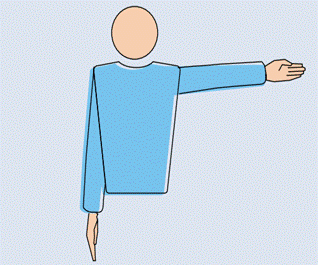
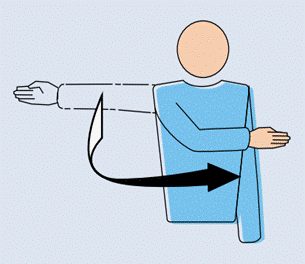
Figure 1. Serving team Figure 2. Authorization to Serve
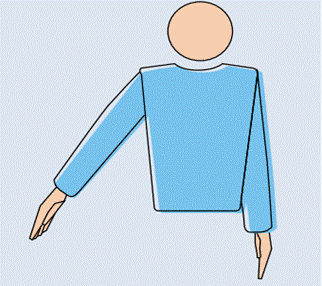
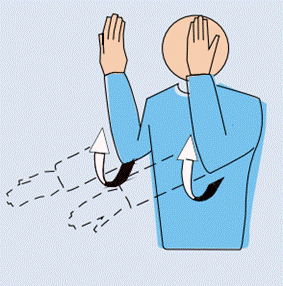
Figure 3. Ball "In" (In-bounds) Figure 4. Ball "Out" (Out-of-bounds)
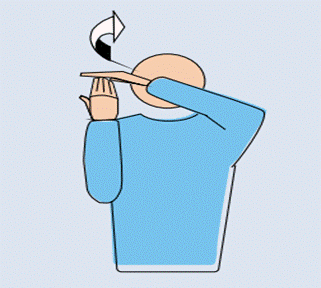
Figure 5. Touched Ball
We next list the fundamental rules and the associated referee signaling. It is up to the teacher how they will integrate these rules into the lesson and to what extent they will be consistent in their enforcement. For instance, in rule 1: player position and rotational order. In our opinion, it is important to strictly adhere to the rotational order; however, when assessing player position, we would opt for a certain degree of benevolence.
Player Position and Rotational Order
At the moment the server hits the ball, players of both teams must be positioned within their own playing area (with the exception of the server). Receiving team players must be in compliance with the rotational order at the moment the server strikes the ball. Serving team players may occupy any position at the moment the server strikes the ball.
Player positions are numbered as follows:
- The three players near the net are the front-row players and occupy positions in zones II, III, and IV.
- The remaining three are the back-row players and occupy positions in zones V, VI, and I (see Fig. 6).[1]
- Players rotate clockwise (I, VI, V, IV, III, II).
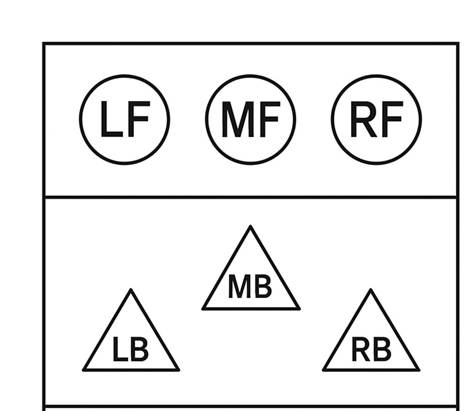
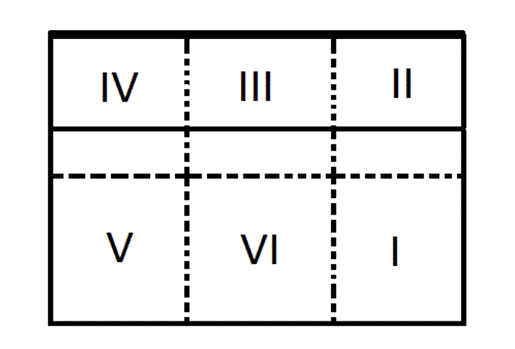
Figure 6. Player Positioning and Zone Numbering
Legend: LF = left forward, MF = middle forward, RF= right forward; LB = left backward, MB = middle backward, RB = right backward,
Relationships Between Player Positions:
- Every player in the back row must be positioned further from the center line than their corresponding player in the front row.
- Players in both the front and back rows must be positioned laterally according to the sequence established by the rule.
The players' positioning is determined and governed by the position of their feet touching the ground in the following manner:
- Every back-row player must be at the same level as, or have at least part of one of their feet further from the center line, than the foot closer to the center line of the corresponding front-row player.
-Every outside player must be at the same level as, or have at least part of one of their feet closer to the sideline, than the feet of the other players in the front row.
A team commits a positional fault if any player is not in their correct position at the moment the server strikes the ball. In this case, the referee signals the fault with the whistle.
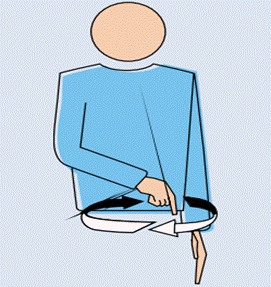
Figure 7. Positional fault
Point Scoring
- Upon the successful landing of the ball on the opponent's playing area (Figure 3. Ball In);
- When the opposing team commits a fault.
Fault:
A team commits a fault by executing an action during play that is contrary to the rules (or violates them in another manner).
Referee rule on faults and their consequences according to the rules:
- If two or more faults occur consecutively, only the first one is counted.
- If two or more faults are committed by both teams simultaneously, it is ruled a double fault, and the rally is replayed..
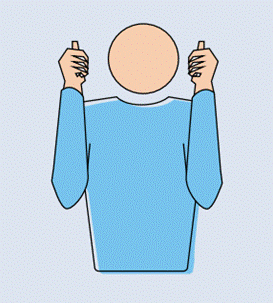
Figure 8. Double Fault - Replay
The Service
The service is the act of putting the ball into play by the right back player who is positioned in the service zone. The first service in the first set, as well as in the decisive fifth set, is executed by the team determined by toss/lot. Subsequent sets shall be started by the team that did not serve first in the previous set. Before serving, players must adhere to the service order listed on the starting lineup sheet. After the first service in the set, the serving player is determined as follows:
- If the serving team wins the rally, the player who served before serves again.
- If the receiving team wins the rally, they gain the right to serve and advance in the rotation order before executing the serve. The player to serve will be the one who moves from Position 2 (right front) to Position 1 (right back).
The first referee shall authorize the service once they have checked that both teams are ready to play and the server is holding the ball (Figure 2. Authorization to Serve).
Execution of the Service:
- The ball must be hit with one hand or any part of the arm after it has been tossed or released from the hand.
- Only one toss or release of the ball is allowed. Dribbling or moving the ball in the hands is permitted.
- At the moment of striking the ball for service or take-off for a jump service, the server must not touch the court (including the end line) or the surface of the playing area outside the service zone. After the strike, the player may step or land outside the service zone or into the court.
- The server must strike the ball within eight seconds after the first referee whistles, thereby giving the authorization to serve.
- A service executed before the referee's whistle is annulled and repeated.
Service Faults
A service fault occurs when the server:
- Violates the rotation order.
- Fails to execute the service correctly
- The ball touches a player of the serving team or does not completely cross the net's vertical plane within the crossing space.
- Flies out-of-bounds.
- Passes over a screen.
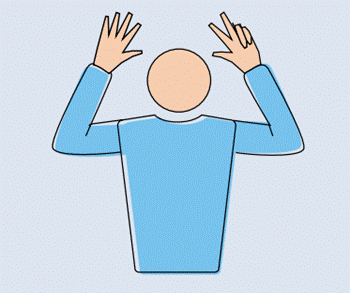
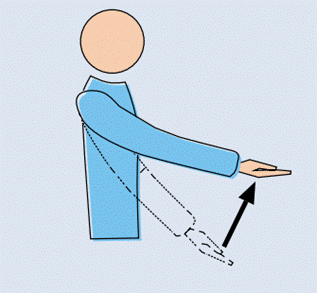
Figure 9. Service Fault - 8 Seconds Violation Figure 10. Service Fault - Ball Not Released/Tossed
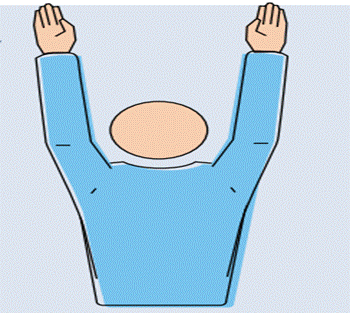
Figure 11. Service Fault - Illegal Screen
Ball in Play and Ball Status
The ball is in play from the moment of the service hit authorized by the first referee.
The ball is "in-bounds" (or "in") if any part of the ball, at any moment during contact with the surface, touches the court, including its boundary lines (Figure 3. Ball In-Bounds).
The ball is "out-of-bounds" (or "out") when:
● All parts of the ball that contact the playing surface land completely outside the boundary lines of the court.
● The ball touches an object outside the court, the ceiling, or a person who is out of play.
● The ball touches the antennae, ropes, posts or the net outside the side bands.
● The ball crosses the net's vertical plane either partially or totally outside the crossing space.
● The ball completely crosses the lower crossing space under the net (Figure 4. Ball Out-of-Bounds).
Team Hits and Contacts
A hit is any contact by a player with the ball in play. Each team is allowed a maximum of three hits (in addition to a block) to return the ball over the net. If a team uses more hits, they commit the "Four Hits" fault.
Successive Contacts
A player may not hit the ball twice in succession (double contact or double hit).
Simultaneous Contacts
Two or three players may touch the ball simultaneously. If two (or three) teammates touch the ball simultaneously, it is counted as two (or three) hits (except when blocking):
● If several players attempt to play the ball but only one actually touches it, only one hit is counted. If the players collide, it is not a fault.
● If both opponents touch the ball simultaneously above the net and the ball remains in play, the team receiving the ball is entitled to another three hits. If such a ball goes "out", it is the fault of the team on the opposite side.
Characteristics of the Hit
The ball may be touched with any part of the body.
The ball must not be caught and/or thrown. It can rebound in any direction.
The ball may touch different parts of the body only if the contacts occur simultaneously.
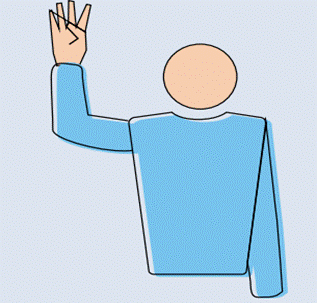
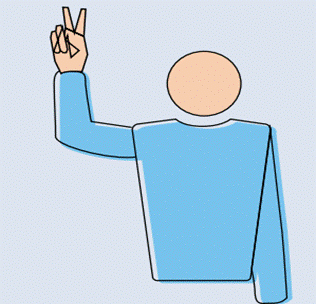
Figure 12. Four Hits Figure 13. Double Contact
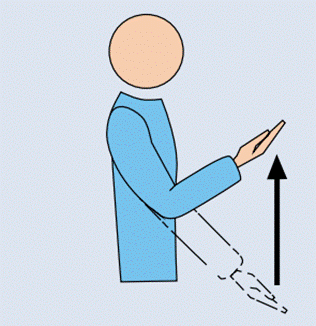
Figure 14. Catch / Held Ball
Exceptions
Blocking: During a block, successive contacts (more than one contact) may occur by one or more blockers, provided these contacts happen during one single action (i.e., immediately one after the other).
First Hit: During the team's first hit of the ball (e.g., receiving a serve or spike), the ball may successively touch various parts of the player's body, provided these contacts occur during one single action.
Net Touch
The ball may touch the net as it crosses. It is a fault if a player touches the net within the area defined by the antennae. Players may touch the net outside the area defined by the antennae.
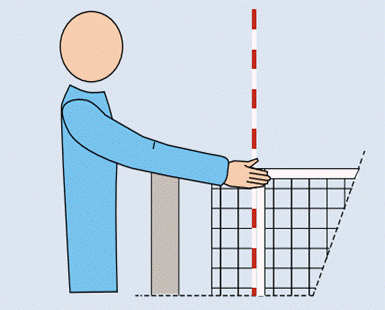
Figure 15. Net Fault
Ball in the Net
A ball hit into the net may be played again, provided it is within the team's allowed three hits. If the ball tears the net mesh or causes the net to come down, the rally is annulled and replayed
Attack and Block Faults
A player hits the ball within the opponent's playing area (Figure 16. Attack Hit Fault).
A player hits the ball "out-of-bounds" (Figure 4. Ball Out-of-Bounds).
A back-row player completes an attack hit from the front zone when the ball is entirely above the level of the top of the net at the moment of contact.
A player completes an attack hit on the opponent's serve if the ball is in the front zone and entirely above the level of the top of the net.
The Libero completes an attack hit if the ball is entirely above the level of the top of the net at the moment of contact.
A player completes an attack hit entirely above the level of the top of the net if the ball is directed to them by the Libero using an overhead finger pass (setting) in their front zone.
A blocker touches the ball in the opponent's space before the opponent's attack hit.
A back-row player or the Libero completes a block or participates in a completed block.
Blocking the opponent's serve.
The ball hit off the block flies "out-of-bounds".
Blocking the ball in the opponent's space from outside the antennae.
The Libero attempts a block alone or participates in a collective block attempt.
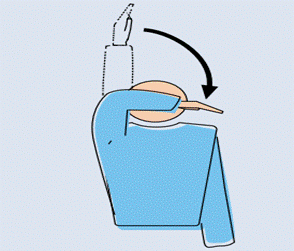
Figure 16. Attack Hit Fault
Time-outs and Substitutions
A request for a time-out must be raised with the appropriate hand signal when the ball is out of play and before the service rally is initiated. All requested time-outs last 30 seconds. For FIVB World and Official Competitions, the duration of the time-out may be adjusted based on the organizer's requirements, only with FIVB approval. For FIVB World and Official Competitions, there is a requirement to request a time-out using an audible signal followed by the hand signal. During all time-outs, the players on the court must go to the free zone near their team bench. A team may request a maximum of two time-outs during one set.
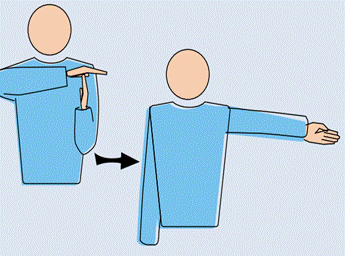
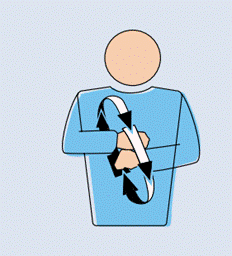
Figure 17. Time-out Signal Figure 18. Substitution
Skill Proficiency Levels
● Level 1 ( PE Lesson, Beginner)
Every decision made by the referee, as a reaction to a violation of the rules during the match, is presented in three steps:
● The referee whistles.
● The referee verbally communicates the type of rule violation (e.g., "Ball out-of-bounds," "Illegal contact," etc.).
● The referee points to the team that will initiate the following rally.
● Level 2 (Inter-School Tournament, Advanced)
● The referee whistles – initiating the rally.
● The referee whistles – ending the rally.
● The referee signals the type of fault and verbally supplements it with the type of violation.
● The referee points to the team that will initiate the next rally.
Images reproduced from: "Fédération Internationale de Volleyball. (2025). Official Volleyball Rules 2025-2028.https://www.fivb.com/wp-content/uploads/2025/01/FIVB-Volleyball_Rules2025_2028-EN-v05.pdf"